For many Microsoft Cloud Solution Providers (CSPs), Azure has long been the cornerstone of their cloud portfolio. Its deep integrations, familiar ecosystem, and enterprise trust make it an unbeatable choice for many customers. But as organizations evolve and diversify their digital strategies, an undeniable shift is taking place — the rise of multi-cloud adoption.
Customers today don’t want to be limited to a single cloud. They want to combine the best of Azure, AWS, Google Cloud, and private environments to achieve flexibility, resilience, and cost optimization. This change presents CSPs with both an opportunity and a challenge: how to expand beyond Azure into a multi-cloud world without losing control, visibility, or profitability.
Why Multi-Cloud Is No Longer Optional for CSPs
The multi-cloud trend isn’t just a passing phase — it’s becoming the new standard in cloud delivery. Businesses are combining multiple cloud platforms to get better performance, security, and value.

Here’s why CSPs can’t afford to ignore it:
- Customer demand for flexibility – Businesses want to run specific workloads where they perform best. Azure may power one part of their environment, while AWS or Google Cloud hosts another.
- Risk reduction and redundancy – Multi-cloud ensures business continuity by spreading workloads across multiple providers.
- Compliance and sovereignty needs – Some industries or regions require local hosting or specific data controls that can’t always be met by a single hyperscaler.
- Competitive differentiation – CSPs offering a broader cloud mix attract clients who seek unbiased consulting and value-added management rather than vendor lock-in.
But stepping into multi-cloud territory without the right framework can quickly lead to complexity, visibility gaps, and operational chaos.
The Hidden Challenges of Going Multi-Cloud
Managing several cloud platforms sounds great — until the day-to-day work begins. Each platform comes with its own tools, billing models, and rules. Without the right system, this can quickly lead to confusion and inefficiency.
Here are some of the most common challenges CSPs face:
- Too many tools and dashboards – Every cloud has a different portal and setup, forcing teams to switch between them constantly.
- Lack of overall visibility – It becomes hard to get a clear picture of usage, costs, and performance across all clouds.
- Complicated billing and reports – Gathering usage data from multiple platforms, applying margins, and generating one clean invoice often takes a lot of manual effort.
- Security and compliance issues – Each cloud follows its own standards, making it harder to keep policies and access control consistent.
- Loss of efficiency and profit – Managing everything separately leads to wasted time, human errors, and hidden costs.
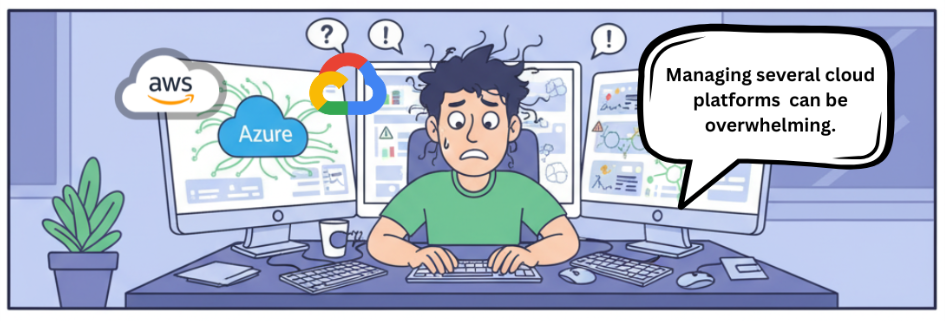
In short, the more clouds you add, the more you risk losing control— unless there’s a unified way to manage it all.
Building a Unified Multi-Cloud Framework
To succeed beyond Azure, CSPs must shift their mindset from “managing multiple clouds separately” to “managing a single, unified cloud experience” — where all clouds can be managed, billed, and monitored from a single place.
Here’s what an effective multi-cloud setup should include:
- Centralized management platform: A single, easy-to-use dashboard where CSPs can view and control all resources across Azure, AWS, Google Cloud, VMware, and on-premises infrastructure.
- Automation for setup and policies: Automating tasks like provisioning, scaling, and applying compliance rules helps reduce human error and speeds up operations.
- Integrated billing and analytics: Combining usage data from multiple platforms into one clear, automated billing system makes it easier to track margins and profitability.
- Unified security and governance: Applying common access controls, security policies, and compliance rules across all clouds ensures safety and consistency.
- Flexible and connected architecture: The framework should easily connect to new clouds, tools, and systems, so CSPs can grow their offerings without reworking everything.
This approach allows CSPs to offer multi-cloud services confidently — with control, visibility, and scalability all in one place.
How Hybr® Empowers CSPs to Go Beyond Azure
For CSPs ready to take the next step, Hybr® by Cloud Assert bridges the gap between Azure and true multi-cloud operations. Designed with CSPs and MSPs in mind, Hybr® unifies management, billing, and governance across diverse cloud platforms — all from a single, intuitive interface.
Here’s how Hybr® helps you go multi-cloud without losing control:
- Unified Cloud Management: Manage Azure, AWS, Google Cloud, VMware, and private environments under one simple interface.
- Automated Billing & Marketplace: Automatically collect usage data, apply margins, and generate accurate, white-labelled invoices for customers.
- Policy-Driven Governance: Enforce security and governance standards across all environments with centralized control.
- Customizable Dashboards: Get clear visibility into costs, usage, and performance through customizable dashboards.
- Scalable Architecture: Easily add new clouds or expand your offerings without disrupting operations.

With Hybr®, CSPs can extend their Azure capabilities while offering customers a truly unified multi-cloud experience — without rebuilding from scratch or sacrificing operational control.
The Future Is Multi-Cloud — and It’s Already Here
The era of single-cloud dependency is ending. Enterprises are looking for partners who can guide them through a multi-cloud, hybrid, and data-centric world — and CSPs that embrace this shift early will lead the way in delivering modern, connected cloud experiences.
Expanding beyond Azure doesn’t mean leaving it — it means extending its reach and connecting it with other clouds and environments. By adopting the right tools and automation, CSPs can manage multi-cloud environments smoothly while keeping control and profitability intact.
Conclusion
Multi-cloud isn’t just about technology — it’s about strategy. CSPs that can deliver seamless, secure, and cost-optimized services across Azure, AWS, Google Cloud, and beyond will stand out as trusted advisors in a competitive market.
Solutions like Hybr® make this possible by giving CSPs a single, intelligent control plane to unify operations, automate billing, and govern multi-cloud environments efficiently.
Beyond Azure lies opportunity — and with Hybr®, CSPs can explore them with complete control and confidence.
Request a demo and discover how Hybr® unifies your multi-cloud management, billing automation, and governance — all in one platform.